It’s 7:43 am. The alarm went off twenty minutes ago. She’s already checked work chat, not because anything was urgent, but because the habit replaced the thought.
She has a good job. A team that functions like a clock. A manager who isn’t a problem. By every measure in the quarterly HR reports, she is fine.
And yet, she is slowly boiling in a cauldron she has no name for.
This is the employee experience in 2026. Not a crisis with a clear edge. Something quieter – a pressure that accumulates in the chest and only becomes visible when someone finally leaves. The research on employee experience caught up to it this year. And what it found is worth reading carefully, especially if you’re the one filling those seats.
Global engagement has hit a new low
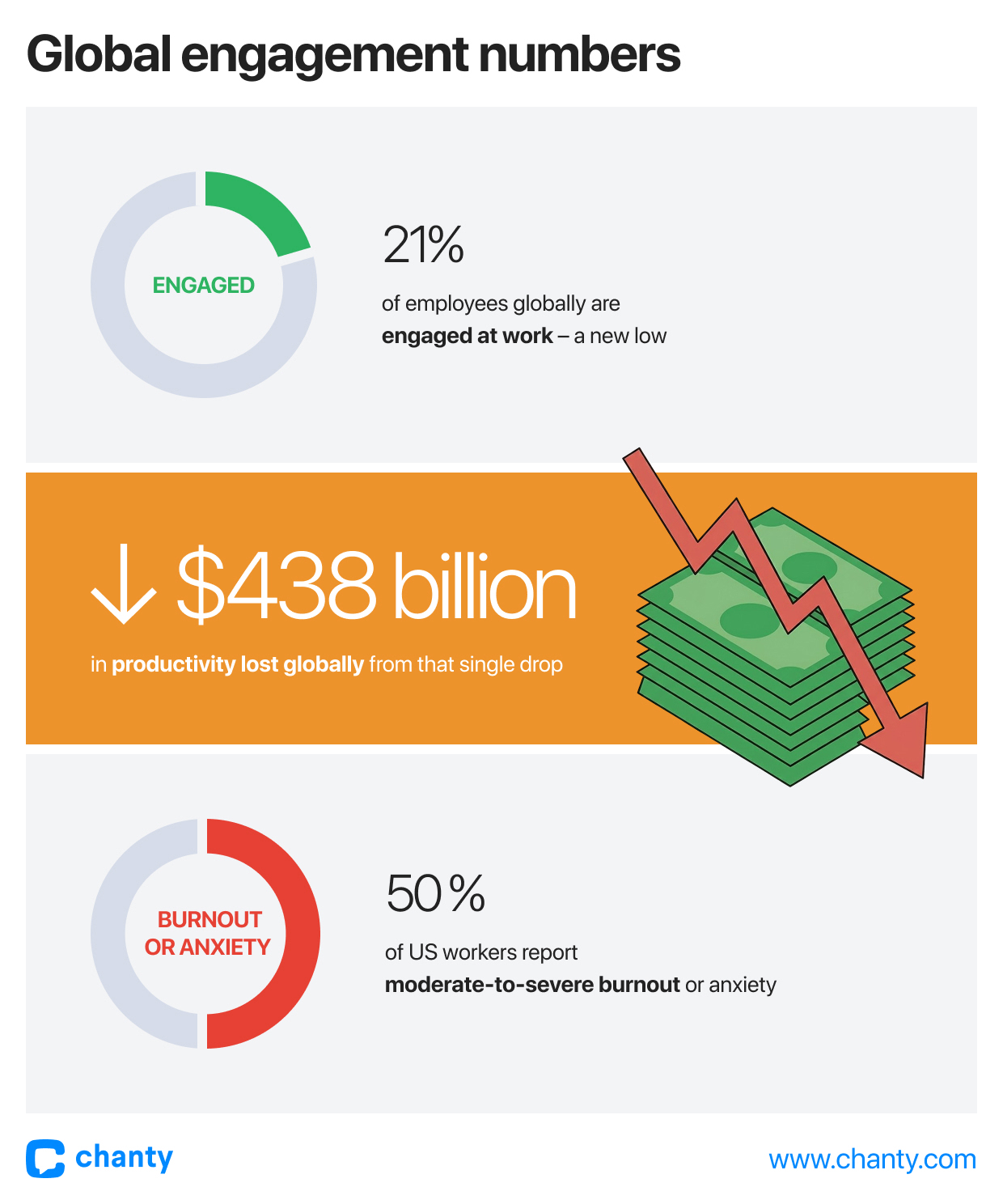
- 21% of employees globally are engaged at work – a new low
- $438B in productivity lost globally from that single drop
- 50% of US workers report moderate-to-severe burnout or anxiety
Gallup tracked global engagement at 23% the year before. It now sits at 21% – a two-point fall that translates, by their own calculation, to $438 billion in lost output. The remaining 79% of the global workforce? Sit somewhere between going through the motions and actively poisoning the well. Present in the body – long gone in everything else.
The office is back. The employees aren’t.
In 2025, the return-to-office wave arrived in force. Mandates came down. Deadlines were set. Explanations, in most cases, were not, and the people who’d spent two years restructuring their lives around flexibility – childcare arrangements, shorter commutes, chronic illness, just the basic math of two hours a day not to lose on a train – were handed a policy memo and told to adjust.
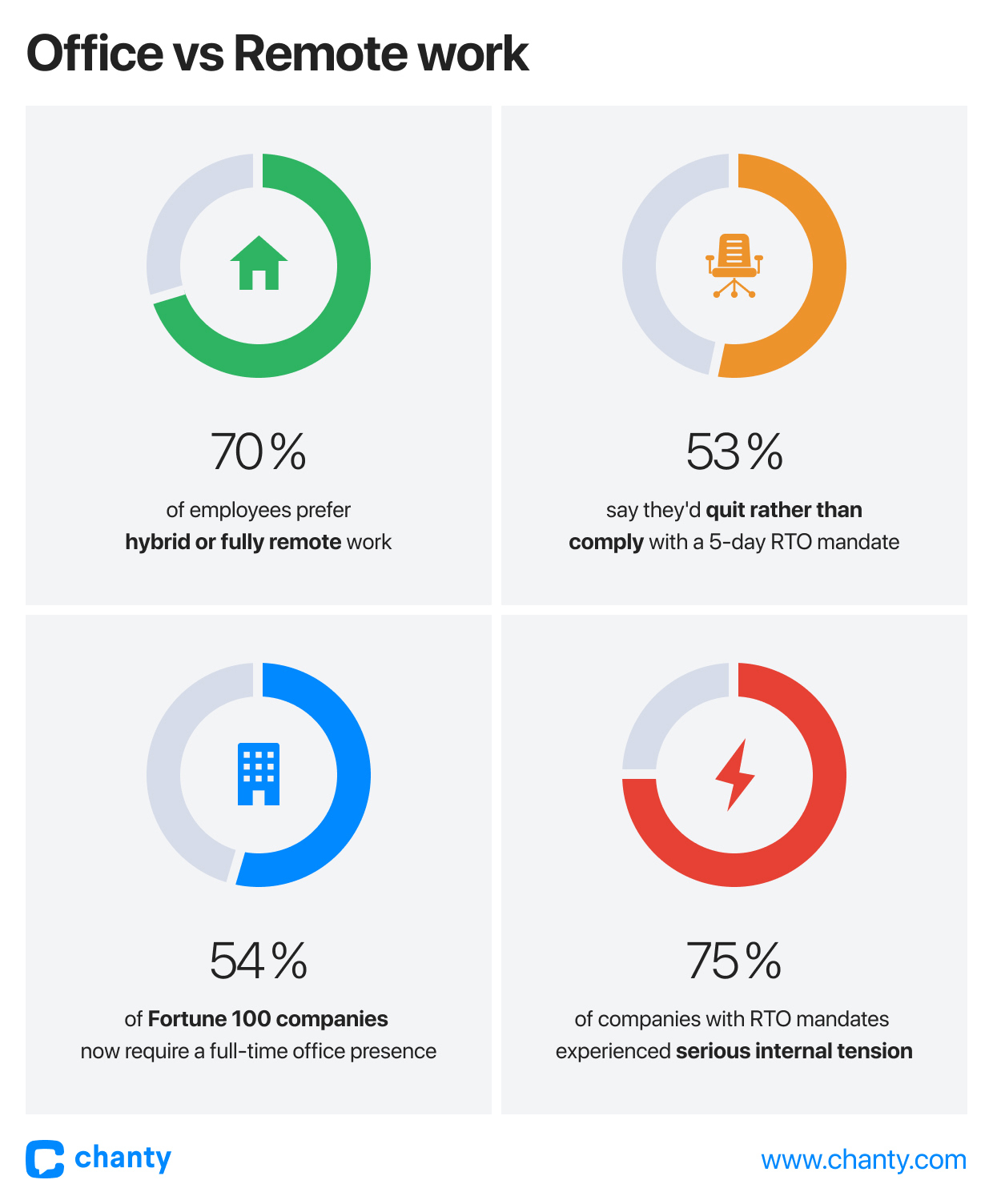
- 70% of employees prefer hybrid or fully remote work.
- 53% say they’d quit rather than comply with 5-day RTO mandate.
- 54% of Fortune 100 companies now require a full-time office presence.
- 75% of companies with RTO mandates experienced serious internal tension.
Required office time went up to 12%. Actual office attendance moved 1-3%. WFH Research named the gap: empowered non-compliers – people skilled enough that the rule doesn’t fully apply to them, and they all know it. When the talent is hard to replace, a mandate becomes a suggestion with paperwork, if your skills are hard to replace.
“Our calls are still virtual… My supervisor is in another state. My supervisor’s supervisor is in a totally different state… The whole thing is absurd.” IRS employee based in Texas, speaking to NPR, 2025
There is something worth naming about what a full return-to-office mandate actually does to someone who spent more than two years learning what life feels like without a commute. It isn’t just inconvenient. It’s a chain put back on someone who learned what it felt like to run free: to pick up a child at 3 p.m., to work an hour of deep focus before the rest of the city is awake, to have an actual life on the other side of closing the laptop. That life is taken back without negotiation, and most people aren’t told why.
The commute isn’t a neutral inconvenience either. According to HealthEquity’s 2025 RTO study, 54% of employees cite commuting costs as their single biggest barrier to office attendance. If in 2022 the average American spent $8,466 per year on commuting, now, by LendingTree’s analysis, the full opportunity cost, including time valued at the wage rate, stands at $9,470 annually. In expensive metro areas, that number climbs past $12,000. For many workers, returning to the office five days a week is not a culture shift. It’s closer to a 19% pay cut on a salary that hasn’t moved. 80% of companies report losing talent over RTO mandates. The resentment doesn’t stay at the station.
Gallup’s own engagement data doesn’t leave much room for debate: fully remote workers are the most engaged group at 31%. Fully on-site sits at the bottom of the ranking. The idea that physical presence drives performance has been tested repeatedly. The results are in.
AI arrived. So did a second job nobody applied for.
The AI rollout of 2024-2025 was sold as a relief. Fewer repetitive tasks. More time for the meaningful work. What arrived instead was an expanded role, the same deadline, and a tool employees were expected to master without dedicated time, employee training, or a clear answer to the most basic question: What am I supposed to do with this?
- 77% of employees say AI tools have lowered their productivity – not raised it.
- 47% can’t meet their employer’s AI-driven productivity targets.
- 40% feel their employer demands “too much” on AI adoption.
UC Berkeley research, covered in Harvard Business Review in February 2026, found the mechanism clearly: employees using AI took on more work voluntarily – broader scope, move varied tasks – but the implicit pressure of being visible as an AI-capable person created a new layer of cognitive load. The tool widened the job; it didn’t shrink it.
There is a hidden cost that doesn’t show up in productivity studies. A growing number of workers describe feeling like a nanny to tools they were told would eliminate repetitive work. They prompt, review, correct, re-prompt, second-guess, and approve – cycling through outputs that are almost right, that need one more pass, that took more judgment to verify than it would have taken to just write the thing. The work didn’t disappear. It was replaced by supervision. And supervising something that moves fast and sounds confident is a particular kind of drain – you can never fully switch off, because the output is always your responsibility, not the machines.
Microsoft’s Future of Work report names what’s underneath this: deskilling. Workers are gaining output hours while quietly losing something harder to measure – the ability to hold a full problem in their head, to write a first draft without reaching for a prompt, to work through a decision without checking what the model thinks first. A Microsoft Research and Carnegie Mellon study found that knowledge workers reported AI made tasks feel cognitively easier, but they were simultaneously ceding problem-solving to the system and focusing instead on gathering and approving responses. Confidence in the tool went up. Capability, over time, went in the opposite direction. 57% of workers now say skill erosion, not job displacement, is their biggest AI-related concern for 2026.
Gartner flagged the downstream consequence “Shadow AI” – workers quietly feeding sensitive company data into consumer tools because the approved ones aren’t good enough. It moved from a theoretical risk to a documented pattern in 2026 breach reporting. No one meant to create a security hole. They were just trying to get through the day.
The team you’re on shapes how you feel about yourself
There is a variable in the employee well-being equation that doesn’t appear on most HR dashboards. It isn’t salary. It isn’t the office policy or the number of meetings. It’s the people in the room, or the chat, and whether being around them makes you feel capable or small.
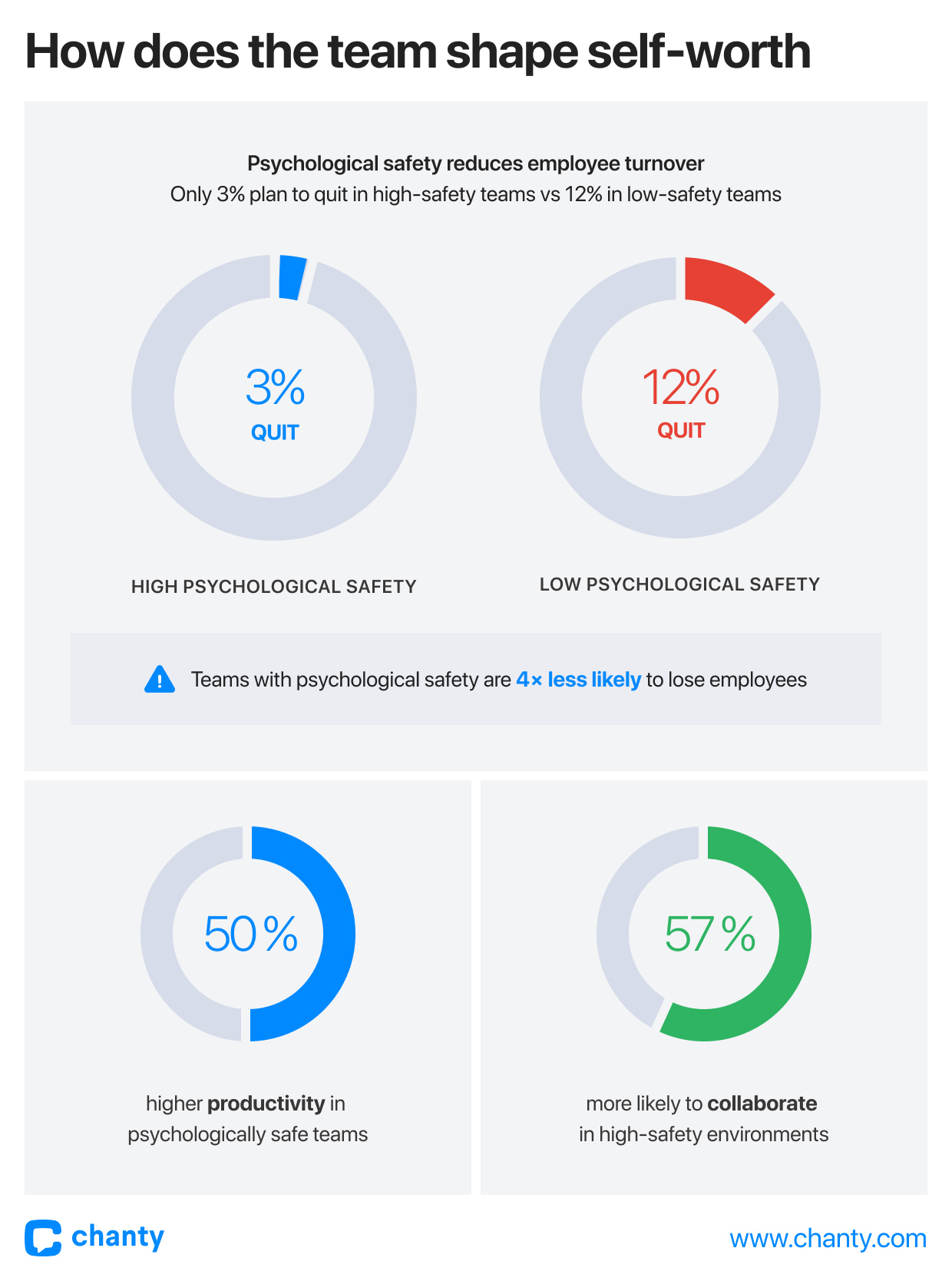
- 3% of employees in high-psychological-safety teams plan to quit vs 12% when it’s low (BCG)
- +50% higher productivity in psychologically safe teams (Gartner/ Gallup/ HBR)
- 57% more likely to collaborate in high-safety environments
Teams with high psychological safety, where a person can admit they don’t know something, raise a concern, or disagree without a social cost, don’t just feel better. They perform measurably differently. Research synthesised from Google’s Project Aristotle and published across multiple peer-reviewed studies shows that teams scoring high on psychological safety report 50% higher productivity, 76% more engagement, and 27% lower turnover risk compared to teams where that safety is absent. A Frontiers in Psychology study involving 529 employees across 282 teams found that psychological safety is the engine of team performance – not the fuel. The environment shapes the output. The people are the same either way.
The relationship between team quality and individual self-worth runs in both directions. People inside bad team environments don’t just underperform – they begin to doubt their own competence. The constant, low-level tension of not feeling safe to speak changes how a person shows up, not just at work, but outside it. How they talk about themselves. Whether they bring ideas or bury them. Research published in PLOS ONE in 2024 confirmed that communication behaviour fully mediates the link between psychological safety and performance: when the environment is safe, people communicate differently, and that shift in communication is the exact mechanism behind better outcomes. Remove the safety – the communication collapses first, the output follows.
The research also reveals which teams avoid conflict and which teams use it well. Psychologically safe teams aren’t conflict-free – they’re conflict-productive. Disagreements about how work gets done, which in a low-trust team fracture into blame and silence, become the creative friction that moves things forward when the foundation is solid. Same argument, completely different ending. The manager who created the environment is the difference, not the team members themselves.
Only 26% of leaders are actively building psychological safety for their teams, per McKinsey. The rest either don’t know what it requires or don’t prioritise it. What it requires isn’t complicated: responding to mistakes by asking what happened instead of who is responsible. Treating a question as curiosity, not incompetence. Meaning what you say in one-to-one meeting. According to the APA’s 2024 Work in America survey of over 2,000 employed adults, workers who reported poor relationships with their manager showed burnout and disengagement at 77% versus 57% among those satisfied with the relationship. The manager is not a factor in the employee experience. The manager IS the employee experience.
Burnout is structural. The yoga mat isn’t going to fix it.
- 82% of workers reported stress, anxiety, or burnout in 2025 (Mercer)
- 84% of employees working significant unpaid overtime report high levels of stress and burnout (NIH)
- 74% of employees reported working while sick at least once this year (SurveyMonkey)
Every year, companies announce new wellness initiatives. Every year, the burnout numbers continue to climb up. In 2026, the gap between what organisations offer and what people actually need has stopped being a nuance – it’s the headline.
Most employees would not tell their manager they were struggling. Not because the EAP number isn’t on the intranet. But because 42% believe it would cost them professionally. The support exists only on paper. The safety to use it doesn’t exist in the room at all.
“More than 60% report feeling overwhelmed to the point of tears in the past year, and nearly one-third have cried at work due to stress.” Allwork.space, 2026
The World Health Organization frames the scale: 12 billion working days lost each year to depression and anxiety. $1 trillion in lost productivity. There aren’t edge cases. They are the operating condition.
What people want. It’s a short list.
Qualtrics ran its 2026 Employee Experience Trends study across nearly 35,000 people in 24 countries. The results didn’t require a consultant to interpret. For the first time in 22 years of this particular dataset, work-life balance ranked above salary as the top priority – cited by 83% of respondents. Not a pension, not a title – the ability to exist outside of work without guilt.
Next to that: a manger who is actually present. Recognition that doesn’t sit behind a promotion. Work that has a reason behind it. And information, knowing what changed, why it changed, and what is expected of them going forward. Gartner found 73% of HR leaders saying their people are fatigued by change – but the fatigue isn’t about change itself. It’s about change that lands without context, from above, with no conversation attached.
New hires make this concrete. Only 44% of people who joined an organisation in the past year plan to stay beyond three years. Onboarding – the window that should answer the question “did I make the right call?” – is consistently one of the worst-rated moments in the entire employee journey. The first impression is being set. It’s just not the one anyone intended.
Conclusion
The data for 2026 isn’t pointing at something coming. It’s describing something already here. Millions of people are inside organisations that don’t see what they’re carrying, and most of them have learned not to say so out loud.
The employee checking the phone at 7:43 a.m. is not a data point. He is engaged enough to show up, skilled enough to stay, and exhausted enough that neither feels like a choice. Not the kind of burnout that makes headlines, but the kind that quietly erodes meaning until the work feels empty.
What she needs is not a wellness programme or a new productivity target. It is something simpler: to be seen as a person, not a throughput. To have a manager who asks and means it. To understand decisions. To be trusted with flexibility, not monitored for compliance.
These are not aspirations. They are the floor. And organisations that treat them that way perform better, retain more, and avoid the cost of disengagement.
Work, at its best, gives people somewhere to put their effort and have it matter. The data for 2026 is the cost of forgetting that.